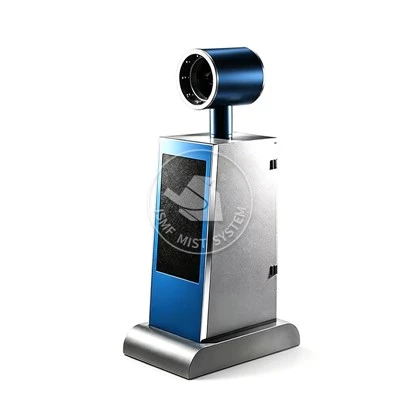

Jinsheng Mist Forest-High Pressure Mist System is one of the leading manufacturers and suppliers of quarry dust control unit in China. If you're going to wholesale cheap quarry dust control unit made in China, welcome to get free sample from our factory. All customized products are with high quality and low price.
The Quarry Dust Control Unit is a packaged high-pressure misting system for localized dust suppression at quarry crushing, screening, conveying, and material transfer points. Filtered water is pressurized to 50–70 bar and delivered through fine-atomizing nozzles that produce typical droplets of 5–15 μm.
The system combines a high-pressure pump, water filtration, pressure regulation, valves, high-pressure piping, and atomizing nozzles. Pump flow, nozzle quantity, piping arrangement, and control zones are selected from the process layout, material throughput, water supply, and dust-source locations.
Operating Principle
Fine Mist Generation: Water enters the filtration stage before reaching the high-pressure pump. Pressurized water then passes through fine-atomizing nozzles to form a mist with typical droplets of 5–15 μm.
Dust-Point Application: Mist is applied close to the dust source rather than distributed across the entire process area. Nozzle position is determined by material movement, equipment geometry, transfer direction, and the location where airborne dust is generated.
Controlled Water Flow: The required water flow is established from nozzle quantity, nozzle flow, operating pressure, and the number of active zones. This provides a defined basis for pump selection and system sizing.
Typical Technical Parameters
|
Parameter |
Typical Value |
|
Working pressure |
50–70 bar |
|
Typical droplet size |
5–15 μm |
|
Water filtration |
5–20 μm |
|
Nozzle material |
Stainless steel |
|
High-pressure piping |
Stainless steel |
|
Pump type |
High-pressure plunger pump |
|
Control mode |
Manual / Automatic |
|
Operating temperature |
5–40°C |
|
Water supply |
Filtered clean water |
|
Installation type |
Fixed / Skid-mounted |
Final pump flow, nozzle quantity, pipe diameter, electrical configuration, and control arrangement are selected according to the application data and installation layout.
Quarry Application Points
Crusher Areas: Primary and secondary crushing points can use localized misting around feed, discharge, and material impact areas. Nozzle placement follows the actual dust-release location and equipment geometry.
Screening Sections: Screening operations can generate dust during material separation and discharge. Dedicated misting points can be arranged around the relevant screen sections and downstream transfer areas.
Conveyor Transfers: Transfer points can receive separate misting zones based on material drop height, conveyor direction, enclosure arrangement, and dust release position.
Loading and Handling: Loading, discharge, and aggregate handling areas can use additional misting points where material movement creates localized airborne dust.
System Configuration
Pump Unit
The high-pressure pump supplies the pressure required for fine atomization. Pump capacity is calculated from total nozzle flow, operating pressure, and the number of nozzles operating at the same time.
Water Filtration
The filtration stage protects the high-pressure circuit and fine-atomizing nozzles from suspended particles in the incoming water. Filter selection is matched to water quality and nozzle requirements.
High-Pressure Piping
High-pressure piping distributes water from the pump unit to each misting zone. Pipe routing is determined by equipment position, line distance, pressure requirements, and access for inspection.
Atomizing Nozzles
Nozzle type, quantity, spacing, and orientation are selected from the dust source and process geometry. The layout is established around the actual treatment points rather than a fixed nozzle pattern.
Selection Criteria
Dust-Source Layout: The number and position of crushers, screens, conveyors, transfer points, and loading areas determine the number of misting zones and nozzle locations.
Material Throughput: Material throughput provides a basis for estimating misting demand. It is considered together with dust-source characteristics when determining pump flow and nozzle quantity.
Water Conditions: Incoming water should be filtered before entering the high-pressure system. Suspended solids, water temperature, and available supply conditions are considered during filtration and nozzle selection.
Site Utilities: Electrical supply, available water, installation space, pipe-routing distance, drainage, and control requirements should be confirmed before final system configuration.
Installation and Maintenance
Pump and Filter Access
The pump and filtration components should be installed where routine inspection and service can be carried out without interfering with quarry operations.
Nozzle Inspection
Nozzles should be inspected for deposits, wear, and changes in spray pattern. Inspection frequency depends on water quality, operating hours, and site conditions.
Filter Service
Filter elements require periodic inspection and replacement. Service intervals are established according to water quality, pressure differential, and operating time.
Outdoor Installation
Outdoor systems should account for ambient temperature, drainage, line protection, and seasonal operating conditions when the installation location is exposed to weather.
Process Integration
Existing Quarry Equipment: The misting network can be routed around existing crushers, screens, conveyors, hoppers, and transfer points while following the established material-handling arrangement.
Zone Control: Individual valve-controlled sections allow separate dust points to operate according to production requirements. Different process areas can therefore use independent operating schedules.
Equipment Interlocking: The control system can be configured to coordinate selected misting zones with associated process equipment. This allows misting operation to follow the operating status of the relevant production section.
Procurement Information
Process Data
Provide the equipment type, dust-source locations, material type, approximate throughput, number of treatment points, and operating schedule.
Water and Electrical Data
Water source, available supply pressure, water quality, electrical voltage, frequency, and available installation space provide the basic utility information for system selection.
Control Requirements
Specify manual or automatic operation, required misting zones, equipment interlocking, and preferred control functions.
Site Layout
A process drawing, equipment layout, or marked site plan helps determine pump location, nozzle positions, pipe routing, valve locations, and maintenance access.
FAQ
Q: What working pressure does the unit use?
A: The typical working pressure is 50–70 bar. Final operating pressure depends on the selected pump, nozzle configuration, and required misting capacity.
Q: What droplet size does the system produce?
A: Typical droplets are approximately 5–15 μm. Actual droplet characteristics vary with nozzle design, pressure, water properties, and operating conditions.
Q: Where can the unit be installed?
A: Typical installation points include crushers, screens, conveyor transfers, hoppers, loading areas, and other defined material-handling locations where dust is generated.
Q: What water quality is required?
A: Filtered clean water is used for the high-pressure circuit. Filtration requirements are selected according to suspended solids, water conditions, and nozzle specifications.
Q: How is the system sized?
A: Sizing is based on dust-source locations, material throughput, number of treatment points, nozzle flow, operating pressure, water supply, piping distance, and required control zones.
Hot Tags: quarry dust control unit, China quarry dust control unit manufacturers, suppliers, factory, Artificial Fog System, Construction dust control, Outdoor Oscillating Misting Fan, portable misting fan , portable misting system for outdoor events, standing misting fan outdoor